Custom Cryogenic Labels
Cryogenic labels rated to -196°C for liquid nitrogen storage — sample tubes, cryoboxes and vials stay correctly identified through the most extreme cold chain conditions.
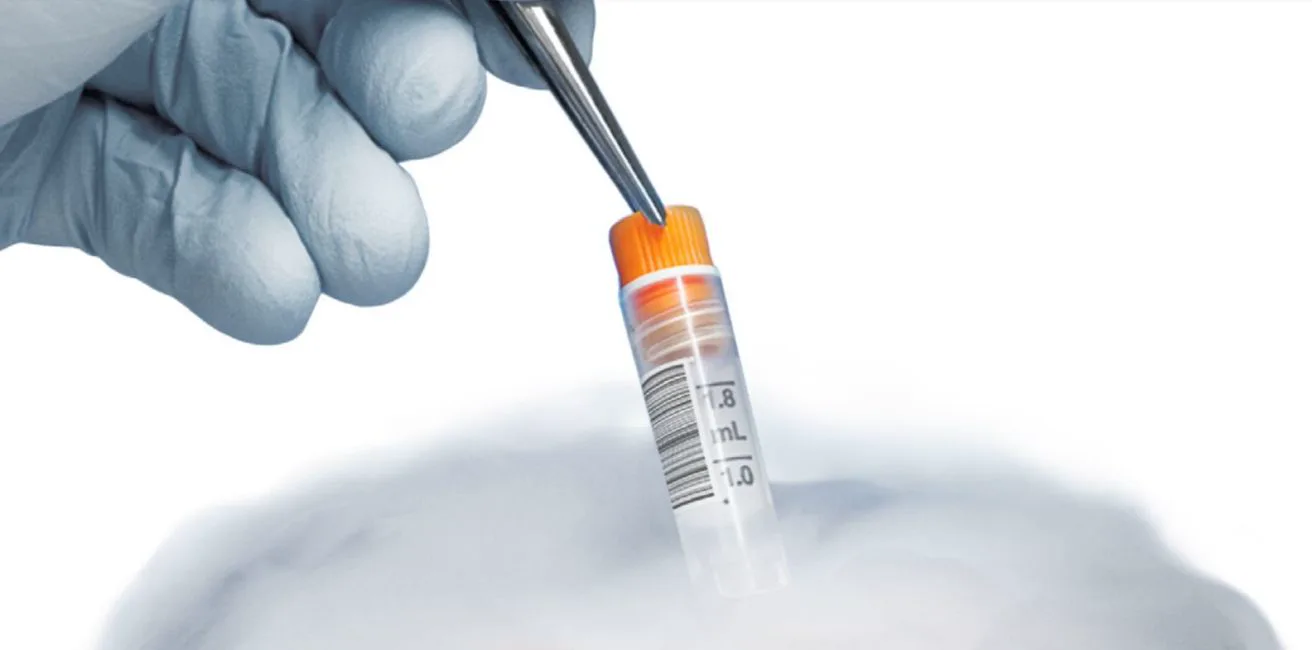
A standard label placed on a cryogenic vial will fall off when the tube is removed from liquid nitrogen — the thermal shock causes the adhesive to embrittle and fail instantly. Adcal's cryogenic labels are manufactured with adhesives and facestocks engineered to survive this cycle. Made in High Wycombe, UK.
Why Standard Labels Fail at Cryogenic Temperatures
Conventional self-adhesive labels are manufactured with pressure-sensitive adhesives based on acrylic or rubber chemistry. These adhesives have a glass transition temperature — a point below which the adhesive becomes rigid and brittle and loses all tack. For standard acrylic adhesives, this transition occurs around -10°C to -20°C. At -196°C, a standard adhesive is not merely weak — it is a rigid solid with essentially no adhesive properties, and the act of removing a tube from liquid nitrogen creates enough thermal and mechanical shock to cause the label to shear off completely.
Cryogenic-rated labels use adhesive formulations with glass transition temperatures below -80°C, maintaining bond integrity through the full cryogenic temperature range. The facestock — typically a biaxially orientated white or clear polyester — remains dimensionally stable and flexible rather than becoming brittle, so it moves with the curved surface of the tube rather than cracking.
Condensation is a secondary failure mode. When a cryogenic tube is warmed to room temperature, moisture condenses on the surface before the adhesive has fully warmed. Cryogenic adhesives are formulated to maintain bond strength through this wet re-warming cycle, which would cause a standard label to lift at the edges.
- Rated to -196°C (liquid nitrogen) — adhesive and facestock both cryogenic grade
- White and clear polyester facestocks — dimensionally stable at ultra-low temperatures
- Cryogenic-rated acrylic pressure-sensitive adhesive — no delamination or peeling
- Print survives LN2 immersion, dry ice (-78°C) and cryogenic freezer (-80°C) storage
- Barcodes, QR codes and sequential numbering printed inline
- Autoclave compatible variants available (134°C, 30 min cycle)
- DMSO and solvent-resistant variants for cell biology applications
- Minimum order 25 labels; custom sizes from 6 mm × 13 mm tube cap to full cryobox label
Temperature Performance Guide
Liquid nitrogen (LN2)
Cryogenic labels — standard
LN2 vapour phase
Cryogenic labels — standard
Ultra-low freezer (ULF)
Cryogenic labels — standard
Standard lab freezer
General cold storage labels
Autoclave (steam sterilisation)
Autoclave-compatible variant
Applications
- Cryogenic sample tubes and microtubes — LN2 storage
- Cryoboxes and cryogenic storage racks
- Embryo and gamete storage — IVF and fertility clinics
- Stem cell banks and tissue repositories
- Blood and plasma sample archival
- Pharmaceutical biobanks
- Research specimen collections